Keep your crew.
Add the office.
A trained project manager runs your jobs (scheduling, subs, change orders, draws), backed by an admin team and software we built ourselves. You stay on the tools, or out selling. Nobody to hire, insure, or find a desk for.
Every outfit hits the same wall.
These are real threads on ContractorTalk, written by owners running businesses like yours. We have not reworded them or lifted anything — go read them in their own words.
The trap has a name, and a size
It starts with a second job running at the same time. Contractors on the forums say the worst of it hits between five and ten on the crew: too much to hold in your head, still too small to carry a full-time manager. Somewhere around twelve, the structure starts to pay for itself. That stretch is where owners burn out, and where a lot of this industry sits. You do not have to be at the far end of it to want the help.
Threads are linked, not reproduced. They belong to the people who wrote them and to ContractorTalk. If it reads like your week, that is the point. It is not you, and it is not your crew. It is what happens when the office side outgrows the one person doing it.
You hired a PM once. You were still working nights.
This is the most common thing we hear, and it is usually read as “project managers don’t work.” It is worth looking at what actually went wrong, because it was probably not the person.
There was nothing to hand over
The schedule was in your head. The sub’s number was in your phone. The receipt was in the center console. A new PM cannot take over a system that only exists in one person’s memory, so they spend six months asking you questions — which is slower than doing it yourself.
What changes here: the system arrives before the person does. Your jobs, contacts, documents and history are in a CRM on day one, so there is something to hand over.
You could not let go, and you were right not to
You came up on the tools. You know how it should be done, and one bad call on a change order eats more than the salary. So you checked everything, which meant you were still doing the job, plus managing someone doing the job.
What changes here: approvals are structural, not a habit you have to break. Money, commitments and anything going to a customer stop at you by default. You are not trusting; you are approving.
One person cannot cover the whole desk
Scheduling, submittals, billing, supplier paperwork, compliance and the phone are different jobs. One coordinator is good at two of them. The other four land back on your truck seat.
What changes here: your PM has an office crew behind them, so the parts they are not best at are still covered, without you putting another body on the payroll for each one.
Then they left, and took it with them
Finding and breaking in a replacement runs $50,000 to $75,000 by the time you count the search, the ramp-up and the months they were half-useful. And everything they knew about your jobs left in their truck.
What changes here: the record is yours and stays put. If we stop working together, the CRM and every job in it remain with you, so nothing has to be rebuilt.
Salary, replacement and bad-hire figures are from published 2026 industry data — construction salary surveys, SHRM replacement-cost guidance, and industry writing on after-hours admin. The patterns above are what contractors describe to us; they are not quotes from named individuals.
Built by the people who run the jobs on it.
Everything else on the market comes from one side of this problem or the other. That is the whole reason it does not fit.
Software from people who have never pulled a permit
Engineers build what looks sensible from a desk. It is why the change order never hits the budget, why the supplier invoice has nowhere to live, and why nothing in it knows what egress means.
And you still have to staff someone to run it.
A coordinator who does not know the trade
They can keep a calendar. They cannot read a window schedule, tell a nominal size from a clear opening, or know that rolling a crew before the power is back burns the whole day.
So the judgment calls come back to you.
Both, from the same people
We run a construction company. We built this software for ourselves first, because nothing on the market did the job, and our own crews and vendor paperwork have been running on it since before it was ever offered to anyone.
So your PM is not learning your trade on your time, and the software was not designed by someone guessing at it.
A team who knows the work, and the system they built to do it.
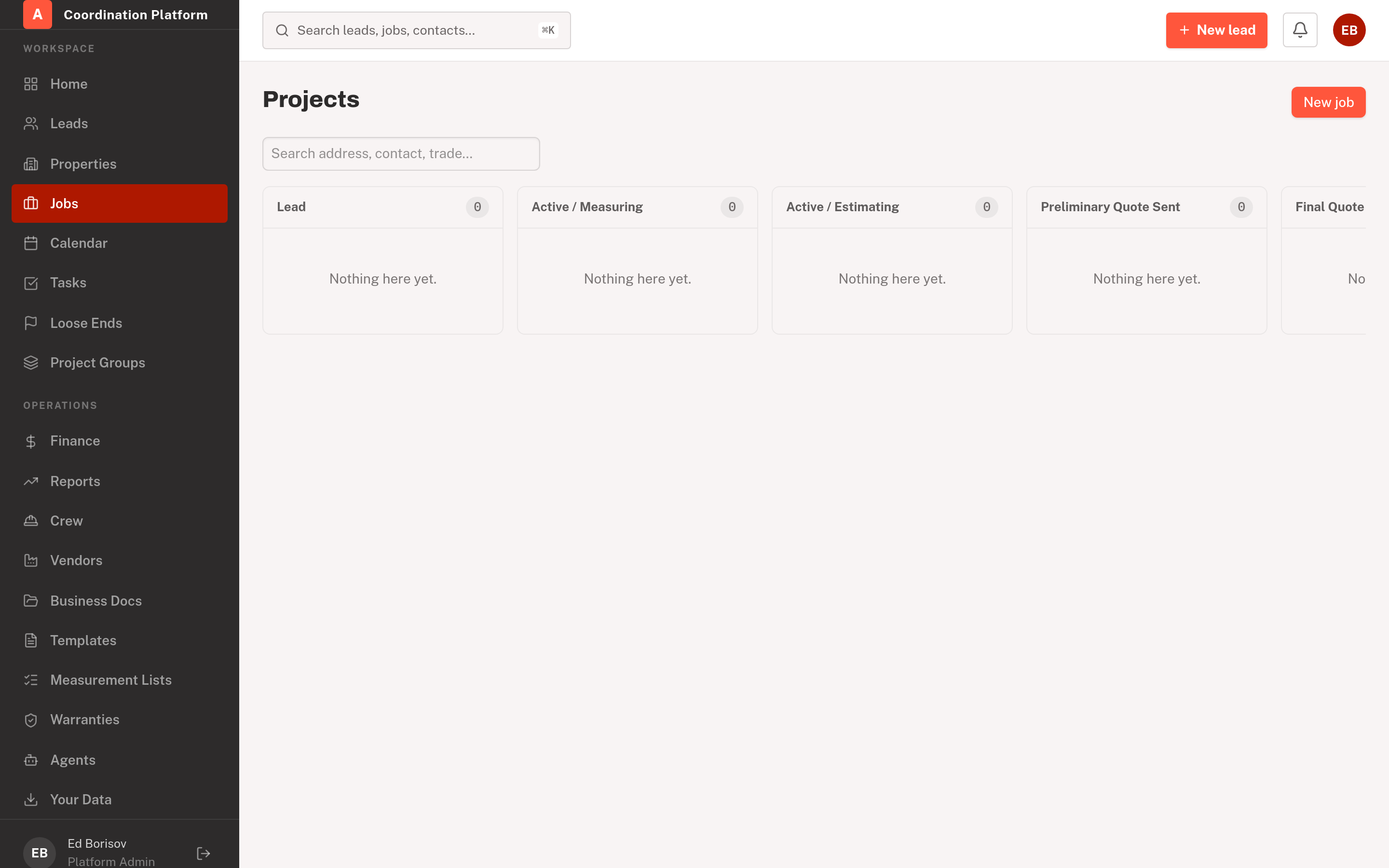
Your whole job, one screen.
A real screenshot of the workspace your PM works in every day.
Coordination, not a calendar
The hard part was never the dates. It is sequencing: power restored before the countertop installer arrives, inspection passed before the drywall goes up. A real CPM engine underneath (dependencies, float, baseline snapshots) means a late delivery shows you everything it takes down with it, the day it goes late rather than the morning a crew is standing in the driveway.
- A crew is never dispatched to a site that is not ready
- Baseline vs. actual, so drift is visible, not a surprise
Change orders that hit the budget
Change orders itemize against specific budget lines, not a free-text total. Approve one and the deltas apply straight to the job's budget grid — no separate reconciliation later.
- Every commitment (PO, sub PO, manufacturer order) ties to a budget line
- Live depletion bars — see a line running hot before it's over
AIA-style progress billing
Schedule-of-values draws with retainage that can step down mid-contract, plus WIP reporting in the format your bank or bonding company actually wants — not a generic invoice export.
- Retainage tracked per invoice, not bolted on after
- WIP report in bonding/accountant format, ready to hand over
Vendor paperwork files itself
Every document is read the moment it lands: what it is, what it totals, which order it belongs to. It is matched to a job by the P.O. number your team wrote on it, or by the window schedule itself.
- Never matched by address — a vendor's letterhead is on every page they send
- Ambiguous ones are held and asked about, never filed on a guess
A real phone number, not an inbox metaphor
Calls and texts run through an actual business line tied to the job, not a shared inbox. Your PM answers, logs a summary, and it's attached to the right customer automatically.
- A real person answers, not a script
- Every call and text logged to the job, automatically
The rest of the desk
A named PM on your account, a trained office crew behind them, and our own software doing the reading, cross-checking and remembering that people do slowly and sometimes miss.
Egress and Title 24, checked
Tempered glass, bedroom egress clear opening, U-factor and SHGC, checked against the measurement before an order goes out. Unrated products are reported separately from failing ones.
Commitments that come back
A vendor owing you a replacement has no due date. It reappears the next time you raise a purchase order against that vendor — tomorrow or in two months.
Sub compliance & lien waivers
License and workers' comp expiration tracked automatically. Subs sign conditional/unconditional lien waivers right from the field.
Homeowner portal
A link, no login, where the homeowner sees where the job is and only the documents you pick. One less password for them to lose.
The checks nobody remembers to run
A window that fails egress fails it after it is installed, which is the expensive moment to find out. Every measurement is checked against the code before it becomes an order, and the answer is arithmetic, not opinion.
Clear opening is not unit size: a slider gives up half its width, a hung unit half its height. That distinction is where bedroom egress usually goes wrong.
Nothing drops. That is the whole job.
The reason contractors lose work is almost never the crew. It is a callback that never happened, an invoice that sat, a permit nobody chased. These are the things you can fire us over.
of all rework on U.S. jobsites traces to miscommunication and poor project information. And the single most-cited cause is people not responding. Not skill. Not materials. Someone not getting back to someone. PlanGrid & FMI, “Construction Disconnected”, 2018 — survey of ~600 construction leaders
Drag the slider. See what a hire actually costs.
Nobody shops this against software plans. You are comparing what a body actually costs you (salary, comp, UI, desk, phone) against a flat monthly number. Set how many jobs you run and look at it.
How many jobs are you running at once?
The more jobs you have going, the faster a W-2 PM's overhead stacks up, and the more you save doing it this way. The salary below is the 2026 median, not a soft number picked to make us look good.
The $116K base sits between the national median and mean for construction managers ($106,980 and $119,660, BLS) and is deliberately conservative for California, where the median runs above $130K. Workers' comp is California clerical class 8810; unemployment is capped by the state's $7,000 taxable wage base and includes ETT and FUTA; health insurance is the average California employer share for single coverage. Your call gets all of it run against your own state and class. None of this counts the cost of a hire that does not work out.
Not another app to run yourself
Everybody else sells you the software and leaves the running of it to you. This is a crew who run your jobs, in software built for how a GC actually works, not service-call scheduling with a construction sticker on it.
| With us | BuilderTrend | ServiceTitan | Procore | |
|---|---|---|---|---|
| Includes a person running your jobs | ✓ Included | ✕ | ✕ | ✕ |
| Dependency-aware coordination, not just a calendar | ✓ | Gantt with dependencies | ✕ | ✓ |
| Change orders linked to budget lines | ✓ | ✓ | ✕ | ✓ |
| AIA-style retainage & WIP reporting | ✓ | WIP yes; AIA retainage limited | ✕ | ✓ |
| Subcontractor lien waivers & compliance tracking | ✓ | ✓ | ✕ | ✓ |
| Reads and files vendor paperwork automatically | ✓ | ✕ | ✕ | ✕ |
| Egress & Title 24 checks on the measurement | ✓ | ✕ | ✕ | ✕ |
| Commitments that resurface when they matter | ✓ | ✕ | ✕ | ✕ |
| Homeowner-facing job portal | ✓ | ✓ | Customer portal (service) | ✕ |
| Built for small and growing contractors, not enterprise GCs | ✓ | ✓ | Service trades | ✕ |
| Typical monthly cost | Flat fee, no seat pricing | Flat subscription, quote-based | ~$245–500/tech/mo, quote only | Enterprise contract |
General positioning based on each vendor's public documentation, verified September 2026, not a paid or affiliated comparison. None of the three publishes full list pricing, so those figures are third-party reported. ServiceTitan is a field-service platform; the construction-PM rows above reflect fit for GC work, not product quality. Confirm current pricing and features directly with each vendor before deciding; we're happy to walk through the differences on a call.
Four steps, no software rollout
Savings call
Your real numbers: what you run, what you carry, what it is costing you.
Job handoff
Your open jobs, your contacts, that folder of supplier paperwork. Spreadsheets import; documents get read and filed.
We run it
Your PM works the job daily, with the admin team behind them. You get told what happened. You do not get homework.
You approve, always
Change orders, payments and commitments come to you before anything is final.
The software stays yours, even if we don't
Every job, contact, and document your PM touches lives in a CRM you own. No black box, and nothing held hostage.
- Full lead-to-close pipeline, not just a job list
- Export everything — contacts, jobs, docs — anytime, no fee
- If you ever bring PM in-house, the system comes with you
- One client across ten addresses groups into a single contract view
- Syncs with QuickBooks and Google Sheets — your books don't move
It is not about how big you are
Some of the best outfits we see are three guys pulling numbers that would embarrass a company four times the size. Headcount tells you almost nothing. How the work goes out, and how people get treated on the way, tells you everything.
Good fit
- Your work holds up. Few go-backs, and the ones you get, you fix
- Your subs get paid and your customers get told the truth
- You are doing quotes at 9pm and invoicing whenever you remember
- More than one job going, or about to be — new outfit or twenty years in
- You would rather be on the tools or selling than chasing paper
- You want a PM in your time zone who speaks the trade — not a call center
- You want somebody on the hook with you — not another dashboard to babysit
× Not a fit
- Enterprise GC with an existing PM department
- Shopping for software only — nobody to run it
- A trail of unpaid subs, liens, or customers who got a different story every week
- Cannot spare five minutes to answer questions about your own outfit
We read public reviews before we take anyone on. Not to judge a bad week (every contractor has those), but a pattern of people not getting paid or not getting the truth tells us how the work would go.
Before you book the call
No. Every PM here is based in California, works U.S. business hours, and speaks English as a first language. There's no call center, no time-zone lag, no outsourcing. You're talking to the same person on your account every time.
A person, assigned to your account, the same one every time, who answers the phone and is accountable for the job. Behind them is a team of trained administrators and software we built ourselves for this trade, which is how one PM covers a desk that would otherwise need three people. What you will never get is a bot making a decision, sending your customer something, or committing you to anything.
They get read and filed against the right jobs. Matching is done on the P.O. number your team wrote on the document, or on the window schedule where there is no P.O. — not the address, since the vendor’s own address is printed on every page they issue and matching on it files everything to the vendor.
Where the evidence is genuinely ambiguous, the document is held and you are asked. An unfiled document is recoverable; one filed against the wrong job is a wrong number in a cost report.
Approve change orders, payments, and anything contractual. We run the operational work; you keep authority over money and commitments.
You export it (jobs, contacts, documents) in full, at no charge, whenever you want. It was never ours to keep.
A W-2 PM costs salary plus payroll tax, workers' comp, unemployment insurance, health coverage and a desk, usually 25–35% on top of salary before software. The calculator above sits at the low end of that range on purpose: it counts only what we can put a source against, and leaves out PTO, retirement and the rest. One PM's overhead is spread across several accounts, so you pay a flat fee instead of carrying all of that alone.
Yes. The CRM and every record in it come with you. Nothing is rebuilt from scratch if you hire your own PM down the road.
Those are software you run yourself. You still staff the person who lives in it every day. This includes that person. On the software side: real critical-path scheduling and budget-linked change orders like Procore, at a flat fee instead of an enterprise contract, sized for a contractor running a handful of crews instead of a large commercial GC.
Yes, and here is exactly where the line sits. The software reads documents, checks measurements against code, and drafts schedules and summaries: the mechanical work a person does slowly and occasionally misses. Every draft is logged and held; nothing becomes a real record on your job without your PM signing it off.
An agent can earn a quieter mode only after 25 consecutive human approvals, and the ones that reach outward (sending your customer a message, moving money, signing something) never earn it at all. That is a rule in the system, not a policy we promise to remember.
We take on a limited number of contractors.
This is an application, not a booking form. Answer a few questions about how you actually run the business and someone will read it properly.
- We look at your company before we decide, including your public reviews
- You hear back either way — no chasing, no drip emails
- Takes about five minutes and you can do it in English or Spanish
Tell us how you run the business
Answer in your own words. It is a conversation, not a form, and the answers are what we use to decide.
Prefer to type it all at once?
Your application is in.
Someone reads every one of these and looks at the company before deciding. You will hear back either way.